
Certification
In contrast to an independent declaration of conformity with the requirements of the standards, Eurolingua and Interlingua Übersetzungen GmbH & Co. KG have two quality management systems that are audited by an independent certification body.
Brief review of developments
ISO 9000ff: general quality standards
The general quality standard ISO 9001:1994 was published in 1994 in three official languages. It sets out 20 requirements for a quality management system: responsibility of management, quality management system, contract audit, design control, control of documents and data, procurement, control of products provided by customers, marking and traceability of products, process control, inspections, inspection equipment monitoring, test status, controlling non-conforming products, corrective and preventive measures, controlling quality records, internal quality audits, training, maintenance, statistical methods and handling, storing, packing, preserving and shipping.
It has been revised on several occasions.
The first revision was in 2000 and was a fundamental revision of the contents. The new edition of the standard was switched to process orientation and renamed ISO 9001:2000. It consisted of eight principles: customer orientation, responsibility of management, inclusion of participating persons, process-oriented approach, system-oriented management approach, continuous improvement, task-oriented decision-making approach, supplier relations for mutual benefit.
Further updating took place in 2005/2008 and 2015.
Specific standards for the translation branch
At first, only those in the know were given it: a bundle of papers entitled “Translation project”. What this tentative wording wanted to express at the beginning of the 1990s developed into a quality standard after many years of work in the Standards Committee for Terminology (Normenausschuss Terminologie (NAT)) of the DIN Deutsches Institut für Normung e.V.: DIN 2345 Translation Orders. In seven chapters the first standard for the translation branch defined and described the application range, the terms used, the process organisation and the audit procedure. (cf. http://www.tekom.de/index_neu.jsp?url=/servlet/ControllerGUI?action=voll&id=761)
DIN 2345 Translation Orders was updated in 1998, withdrawn in full in 2006 and replaced by DIN EN 15038 Translation Services – Service Requirements.
The standard, which set new benchmarks, showed its intentions immediately in its title and made a series of demands on translation service providers that had not been common up to then: the translation services provider should work with well-trained employees who have a range of competences available: cultural competence, research competence, linguistic competence, native language competence, translating competence, etc. The new standard coined terms such as “translation project”, “project manager”, “locale”, “text type”, “register”, etc., and stipulated that translation projects are processed in accordance with documented procedures and monitored by project managers.
The standards were developed still further in some areas and in mid-2016 DIN EN 15038 was replaced by the international translation standard DIN EN ISO 17100 Translation Services – Requirements for Translation Services.
ISO 17100 defines the requirements for all aspects of the translation process that are essential for the quality and provision of translation services. It contains provisions for translation service providers “on handling core processes, on the minimum requirements for qualifications, availability and use of resources as well as on other activities that are required for the provision of high quality translation services”. Along with a structural redesign, new requirements such as the specific processing of customer feedback, taking data protection regulations into account, or verifying the competences for project managers were included. With regard to technical equipment, express reference was made to the use of translation technology and translation tools.
Eurolingua began building its quality management system in 1994, guided by ISO 9001:1994 and the draft of DIN 2345 Translation Orders. The concept drew on the company’s own experience since 1989, building on Interlingua’s experience since 1976, so the essential features of DIN 2345 were integrated into the general quality management system from the start. The first certification to ISO 9001:1994 by MPA NRW followed in 1997; in 2000 the system was converted to the process-oriented edition ISO 9001:2000.
When DIN EN 15038:2006 Translation Services – Service Requirements was published, the scope of the ISO 9001 certification was extended in 2006 to translation services under this standard. On 13 February 2009 Eurolingua obtained a separate certificate for the translation standard (reissued on 6 May 2010), and on 26 January 2015 both systems were confirmed to ISO 9001:2008 and DIN EN 15038:2006. Certification to the international successor standard DIN EN ISO 17100, the current standard for translation service providers, took place on 8 March 2017.
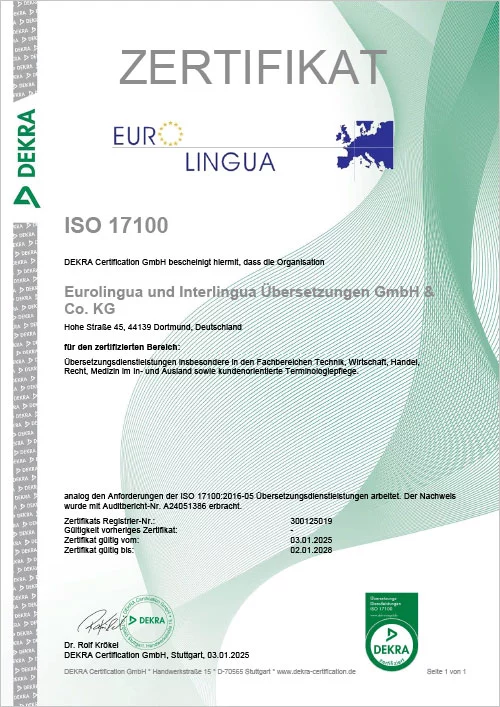
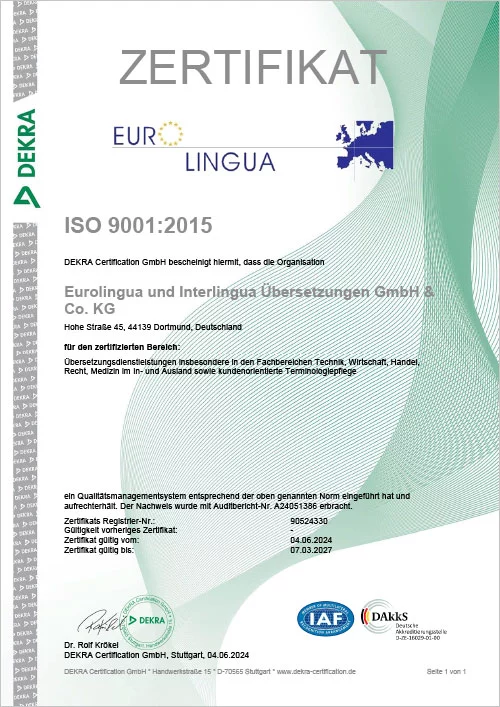
Eurolingua has also implemented every revision of the ISO 9000 series and has been certified to DIN EN ISO 9001:2015 since 25 January 2018. In 2021 the certification body changed to TÜV ProfiCert (ISO 17100 from 26 January 2021, ISO 9001 from 8 March 2021), and in 2024/2025 to DEKRA, which audited both systems within the running cycle: the ISO 9001 certificate was issued on 4 June 2024 and is valid until 7 March 2027, the ISO 17100 certificate on 3 January 2025, valid until 2 January 2028.
Both systems are certified by DEKRA and have been confirmed in annual audits since 1997.
In the framework of quality management systems in accordance with the standards DIN EN ISO 9001:2015 and DIN EN ISO 17100 Eurolingua und Interlingua Übersetzungen GmbH & Co. KG has committed itself to compliance with a quality policy with the primary objective of achieving the best possible customer satisfaction and its continuous improvement. External audits and recertifications, and the company’s own reviews with regard to compliance with the requirements of the standards and to monitoring the quality policy, constitute major elements of the quality management system.
Eurolingua und Interlingua Übersetzungen GmbH & Co. KG ensures that the processes that are required for the preparation of high quality, scientifically substantiated and on-schedule translations are defined, planned and realised. The QM system also takes other factors into account that have a great influence on the quality of products and services, such as the company’s strategic alignment, regulatory and statutory requirements, or knowledge management in the company. Customer orientation also covers other interested parties such as employees, suppliers and service providers. Risks and chances are analysed and evaluated, measures stipulated to minimise risks and their efficacy monitored.
Our specialist translators cover a wide range of industries and fields. Explore our other areas of expertise: